2 number New World Encyclopedia
페이지 정보
작성자 Marlon 작성일26-07-10 01:11 조회58회 댓글0건관련링크
본문
2 number New World Encyclopedia
20
30
40
50
60
70
80
90
>>
duo- bi- (from )
twi- (Old English)
2 (two) is a , numeral, and that represents the number. It is the natural number that follows and precedes . It is an and a cardinal number, that is, a number that is used for counting. In addition, it is classified as a real number, distinguishing it from imaginary numbers.
The number two also represents a pair or . In , sexual reproduction requires the mating of two , male and female, or the uniting of materials provided by male and female organisms. Eastern philosophy points to such dual characteristics as masculinity and femininity (in the animate world), or positivity and negativity (in the inanimate world), and categorizes them as and (in Chinese). Although some consider good and as an example of Yang-Yin characteristics, there is a fundamental difference: evil (such as hatred and violence) flourishes by destroying goodness (such as love and kindness), whereas male and female flourish and multiply their kind by uniting in harmony and love.
Evolution of the glyph
The currently used in the Western world to represent the number 2 traces its roots back to the Brahmin Indians, who wrote 2 as two horizontal lines. (It is still written that way in modern Chinese and Japanese.) The Gupta script rotated the two lines 45 degrees, making them diagonal, and sometimes also made the top line shorter and made its bottom end curve towards the center of the bottom line. Apparently for speed, the Nagari started making the top line more like a curve and connecting to the bottom line. The Ghubar Arabs made the bottom line completely vertical, and now the glyph looked like a dotless closing question mark. Restoring the bottom line to its original horizontal position, but keeping the top line as a curve that connects to the bottom line leads to our modern glyph.
In fonts with text figures, 2 usually has the same height as a lowercase X, for example, .
In mathematics
Two has many properties in mathematics. An is called even if it is divisible by 2. For integers written in a numeral system based on an even number, such as and , divisibility by 2 is easily tested by merely looking at the one's place digit. If it is even, then the whole number is even. In particular, when written in the decimal system, all multiples of 2 will end in 0, 2, 4, 6, or 8.
Two is the smallest and first prime number, and the only even one. (For this reason, it is sometimes humorously called "the oddest prime".) The next prime number is . Two and three are the only two consecutive prime numbers. 2 is the first Sophie Germain prime, the first factorial prime, the first Lucas prime, and the first Smarandache-Wellin prime. It is an Eisenstein prime with no imaginary part and real part of the form
3
n
−
1
\displaystyle 3n-1
It is the third Fibonacci number, and the third and fifth Perrin numbers.
Despite being a prime, two is also a highly composite number, because it has more divisors than the number one. The next highly composite number is .
Vulgar fractions with 2 or 5 in the denominator do not yield infinite decimal expansions, as is the case with most primes, because 2 and 5 are factors of , the decimal base.
Two is the base of the simplest numeral system in which natural numbers can be written concisely, being the length of the number a logarithm of the value of the number (whereas in base 1 the length of the number is the value of the number itself); the binary system is used in .
For any number x:
Two also has the unique property that 2+2 = 2•2 = 2²=2↑↑2=2↑↑↑2, and so on, no matter how high the operation is.
Two is the only number x such that the sum of the reciprocals of the powers of x equals itself. In symbols:
∑
k
=
0
∞
1
2
k
=
1
+
1
2
+
1
4
+
1
8
+
1
16
+
⋯
=
2.
\displaystyle \sum _k=0^\infty \frac 12^k=1+\frac 12+\frac 14+\frac 18+\frac 116+\cdots =2.

This comes from the fact that:
∑
k
=
0
∞
1
n
k
=
1
+
1
n
−
1
for all
n
∈
R
>
1.
\displaystyle \sum _k=0^\infty \frac 1n^k=1+\frac 1n-1\quad \mboxfor all\quad n\in \mathbb R >1.

Powers of two are central to the concept of Mersenne primes, and important to . Two is the first Mersenne prime exponent.
Taking the square root of a number is such a common mathematical operation, that the spot on the root sign where the exponent would normally be written for cubic roots and other such roots, is left blank for square roots, as it is considered tacit.
The square root of two was the first known irrational number.
The smallest field has two elements.
In the set-theoretical construction of the natural numbers, 2 is identified with the set
∅
,
∅
\displaystyle \\\emptyset \,\emptyset \
Two is a primorial, as well as its own factorial. Two often occurs in numerical sequences, such as the Fibonacci number sequence, but not quite as often as one does. Two is also a Motzkin number, a Bell number, an all-Harshad number, a meandric number, a semi-meandric number, and an open meandric number.
Two is the number of n-Queens Problem solutions for n = 4. With one exception, all known solutions to Znám's problem start with 2.
Two also has the unique property such that:
and also
for a not equal to zero
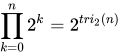
Two has a connection to triangular numbers:
∏
k
=
0
n
2
k
=
2
t
r
i
2
(
n
)
\displaystyle \prod _k=0^n2^k=2^tri_2(n)
Where
t
r
i
d
(
n
)
=
1
d
!
∏
k
=
0
d
−
1
(
n
+
k
)
if
d
≥
2
\displaystyle tri_d(n)=\frac 1d!\prod _k=0^d-1(n+k)\quad \mboxif\quad d\geq 2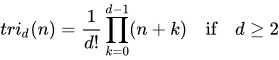
t
r
i
2
(
n
)
=
n
2
+
n
2
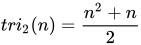
\displaystyle tri_2(n)=\frac n^2+n2
The number of domino tilings of a 2×2 checkerboard is 2.
In science
In , 2 is the of . Group 2 in the of elements consists of the metals, which commonly have a valence of +2. Also, period 2 in the periodic table consists of the eight elements through .
In the structures of many living (especially ), various features occur in pairs. Examples include: , , nostrils, jaws, forelegs (or arms), hind legs, , , and so forth.
Sexual reproduction requires the mating of two organisms, male and female, or the uniting of materials provided by male and female organisms.
Studies in molecular biology have shown that each of usually consists of two polynucleotide strands that form a double helix.
There are two opposite and complementary electrical charges: positive and negative. Both are needed and work together in the formation of and .
There are two opposite and complementary magnetic poles: north and south. Both play a part in setting up a magnetic field.
In the electronic configuration of an atom, a maximum of two (of opposite spin) may occupy a given orbital at any instant.
In nuclear physics, 2 is the first magic number. A magic number (in this case) is the number of nucleons ( and ) in the atomic nucleus, such that they are arranged into complete shells in the nucleus.
In religion, philosophy, and culture
International maritime pennant for 2
International maritime signal flag for 2
In Eastern philosophy, a well-known is that of and (in Chinese), or Yang and Eum (in Korean). They stand for pairs of characteristics such as masculinity and femininity, or positivity and negativity. Some consider good and as an example of Yang-Yin characteristics, but there is a fundamental difference: evil (such as hatred and violence) flourishes by destroying goodness (such as love and kindness), whereas male and female flourish by uniting in harmony.
In ideology, a pair known as "thesis" and "antithesis" have to clash with each other for progress to occur. This philosophy, however, became a justification for class warfare, in which the "lower class" were encouraged to destroy the "upper class." By contrast, various major religions place value on all people, regardless of class, encouraging harmony among people guided by God's love.
The twos of all four suits in playing cards.
Two (二, èr) is a good number in Chinese culture. There is a Chinese saying "good things come in pairs." It is common to use double symbols in product brand names, such as double happiness, double coin, double elephants, and so forth. people like the number two because it sounds the same as the word "easy" (易) in Cantonese.
See also
Notes
References
ISBN links support NWE through referral fees
ISBN links support NWE through referral fees
All links retrieved June 13, 2023.
Credits
New World Encyclopedia writers and editors rewrote and completed the Wikipedia article
in accordance with New World Encyclopedia . This article abides by terms of the (CC-by-sa), which may be used and disseminated with proper attribution. Credit is due under the terms of this license that can reference both the New World Encyclopedia contributors and the selfless volunteer contributors of the Wikimedia Foundation. To cite this article click here for a list of acceptable citing formats.The history of earlier contributions by wikipedians is accessible to researchers here:
The history of this article since it was imported to New World Encyclopedia:
Note: Some restrictions may apply to use of individual images which are separately licensed.
댓글목록
등록된 댓글이 없습니다.